India raises concerns to Colombo and Male regarding approaching Chinese survey vessel
Throughout 2023, up to ten Chinese Yuan Wang series intelligence-surveillance-reconnaissance ships were spotted in the Indian Ocean Region
New Delhi, December 15: Amidst escalating concerns, India has raised red flags directed at Colombo and Male regarding the imminent arrival of a Chinese Research Survey Vessel in their ports. The vessel in question, Shi Yan 6, recently completed its survey near Sri Lanka and subsequently made its way to Singapore by December 2. Beijing, seeking authorisation from both Sri Lanka and the Maldives, intends to dock another Research Survey Vessel for an extensive deep-water exploration of the South Indian Ocean from January 5 until late May 2024.
The backdrop to this impending exploration involves India's explicit objection and diplomatic efforts to dissuade Sri Lanka and the Maldives from permitting the Chinese vessel to engage in oceanic exploration within the Indian Ocean. India's primary concern revolves around potential implications for future military operations arising from this extensive exploration.
The vessel slated for this exploration, Xiang Yang Hong 03, is presently situated off the coast of Xiamen within the South China Sea. Its trajectory involves traversing through the Malacca Strait en route to Colombo and Male, contingent upon securing the necessary permissions for docking and exploration activities.
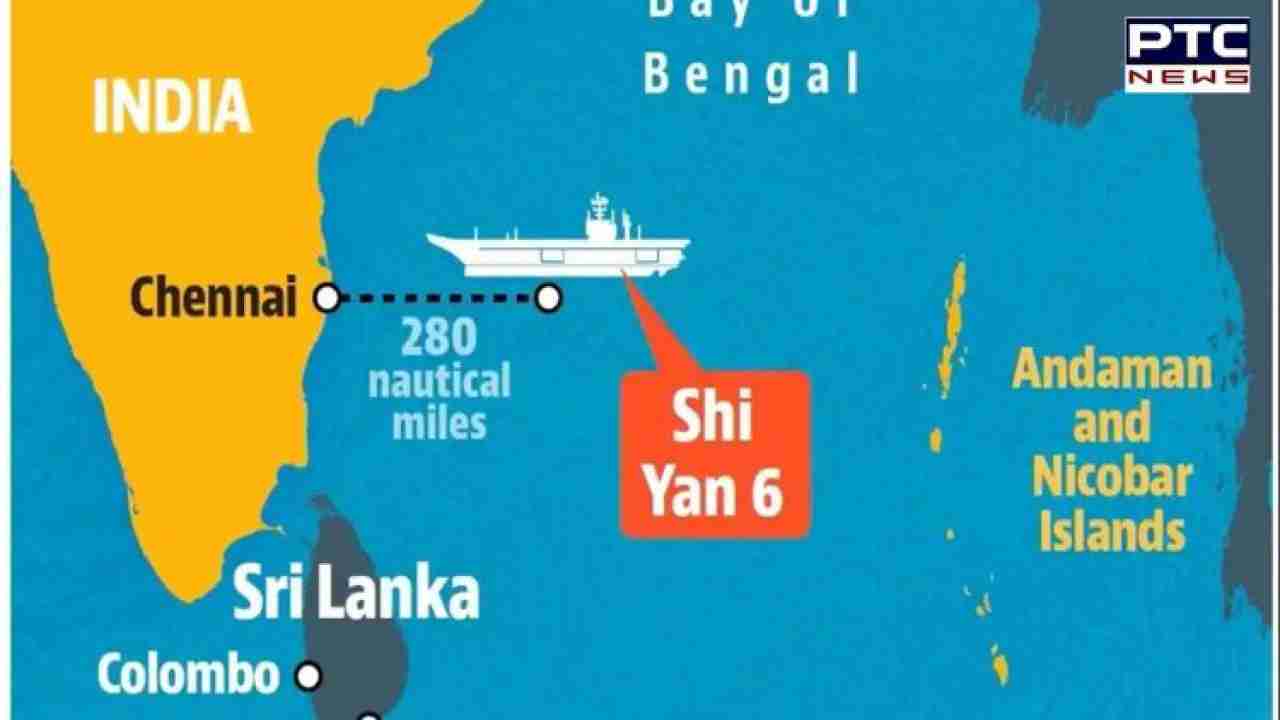
Launched in 20126, the Xiang Yang Hong 03 emerges as a formidable vessel, boasting a weight of 4813 tons and equipped with cutting-edge survey and surveillance apparatus. Its home port is registered at Xiamen, solidifying its credentials as a vessel geared towards advanced exploration capabilities. Its predecessor, the Shi Yan 6, notably secured permission from the Ranil Wickremesinghe government, despite staunch objections from India. Exiting the Malacca Straits on November 20, this vessel conducted extensive exploration within Sri Lanka's Exclusive Economic Zone (EEZ) and across the South Indian Ocean. Its trajectory included a sighting merely 500 nautical miles off the coast of Chennai before docking at Colombo port on October 25, 2023.
India remains deeply perturbed by the allowance granted by Sri Lanka for Chinese vessels, especially those equipped for ballistic missile tracking and reconnaissance, to operate within its vicinity. With a newly pro-China government in the Maldives, these concerns amplify as India fears Beijing might exploit these vessels under the guise of marine exploration to conduct espionage operations directed at India.
The gravity of this situation was underscored last year when Prime Minister Narendra Modi articulated India's apprehensions during discussions with President Ranil Wickremesinghe on July 21, 2023. He emphasised the necessity for Sri Lanka to consider and uphold India's strategic concerns regarding such activities in the region.
Amidst the rapid expansion of the People's Liberation Army (PLA) Navy, which has been aggressively augmenting its maritime arsenal, including the addition of three aircraft carriers, nuclear submarines, and guided missile destroyers, China's presence across the Indian Ocean is notably burgeoning. Establishing a network of naval bases stretching from Cambodia to Djibouti at the mouth of the Red Sea, China's maritime ambitions have taken root. The nation has made substantial investments and acquisitions in port facilities across various strategic locations such as Cambodia, Myanmar, Sri Lanka, Pakistan, Iran, and the UAE, laying the groundwork for potential future naval operations.
Under the guise of marine exploration, Beijing is, in fact, meticulously charting the topography of the Indian Ocean bed, spanning from the ninety-degree ridge located south of the Andaman and Nicobar Islands to the expansive depths of the South Indian Ocean. This extensive mapping effort aims to craft detailed ocean bed maps, serving as crucial blueprints for prospective submarine maneuvers, potentially extending all the way to the coast of Africa. Such comprehensive mapping facilitates strategic planning for future PLA submarine operations.
Already engaged in operations off the coast of Africa and the Gulf of Aden in the name of anti-piracy endeavors, the PLA seems poised to escalate its presence further. This trajectory suggests an eventual deployment of Chinese carrier strike forces patrolling the international waters of the Indian Ocean. Notably, recent activities showcased China's military collaboration with the Pakistan Navy, as witnessed during an exercise conducted off the Makran Coast. During this exercise, a PLA Song-class diesel hunter-killer submarine partook in specialized "sea bottoming" operations, marking a demonstration of specialized naval maneuvers conducted alongside Pakistan, a strategic ally of China.