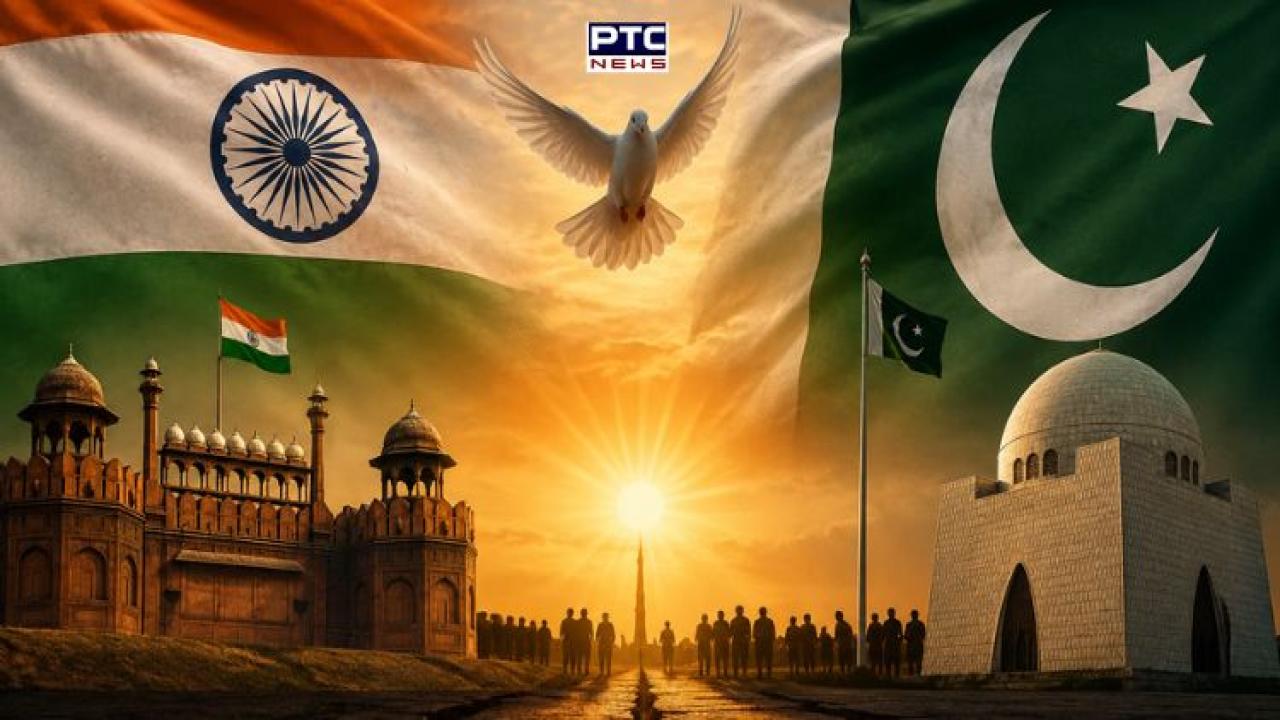
Why India celebrates Independence Day on August 15 while Pakistan marks it on August 14





Independence Day 2026: India and Pakistan will celebrate their 79th Independence Day this week, nearly eight decades after the end of British rule and the Partition of the subcontinent.
India observes Independence Day on August 15, while Pakistan celebrates its national day on August 14. The difference often raises a historical question: if both countries emerged from British India at the time of Partition, why do they have different Independence Day dates?
Historical records provide a more complicated answer than the dates on today's calendars suggest.
Also Read | Is 2026 India's 79th or 80th Independence Day? Here's the real answer
The legal foundation for the creation of India and Pakistan was the Indian Independence Act, 1947, passed by the British Parliament in July 1947.
The Act provided for the creation of two independent dominions, India and Pakistan, from August 15, 1947. In legal terms, therefore, both countries were established under the same legislation and at the same point in time.
The formal transfer of power, however, took place through separate ceremonies because the last Viceroy of India, Lord Louis Mountbatten, had to be physically present in both Karachi and Delhi.
Mountbatten's schedule is one of the main reasons behind the different dates followed today. He travelled to Karachi and attended the transfer-of-power ceremony there on August 14, 1947. He then returned to Delhi for India's independence ceremonies on August 15.
During his address to Pakistan's Constituent Assembly on August 14, Mountbatten referred to the new government taking charge the following day.
Pakistan's founder, Muhammad Ali Jinnah, also described August 15 as the birthday of the country's independent and sovereign state in a radio address.
Historical accounts, including the biography of Mountbatten by Philip Ziegler, have documented August 15 as the date specified for the independence of both dominions.
The practical problem was simple: the transfer of power required the Viceroy's presence. Mountbatten was still the representative of the British Crown when power was handed over in Pakistan. He could therefore participate in the Karachi ceremony on August 14.
He then travelled to Delhi for the Indian independence ceremonies the next day.
Historian KK Aziz, in Murder of History, argued that this sequence should not be interpreted as meaning that Pakistan legally became independent a day earlier.
The Indian Independence Act had specified August 15 as the date on which the two dominions would come into existence.
Records held by the University of Southampton's Broadlands Archives, which contain Mountbatten's papers, also document the two-stage process. A ceremony was held at Karachi's Legislative Assembly on August 14, after which Mountbatten flew back to Delhi. The following day, August 15, the formal independence ceremonies took place in India.
Later on August 15, a resolution was passed declaring India's independence and inviting Mountbatten to serve as the country's first Governor-General.
Another explanation is linked to the Islamic calendar.
The night of August 14-15, 1947 coincided with the 27th night of Ramadan in the Islamic calendar. The night is widely associated with Laylat al-Qadr, considered one of the holiest nights in Islam.
Because Pakistan was established as a Muslim-majority country, some historians have suggested that the coincidence may have influenced the eventual choice of August 14 as the country's national day.
However, the historical record does not establish this as the sole reason for the change.
Time zones provide another explanation that is sometimes cited. Pakistan's standard time is 30 minutes behind India's. As a result, when it was midnight in Delhi on August 15, the local time in Karachi was still 11.30 pm on August 14.
However, this factor alone does not explain the legal date of independence. The Indian Independence Act continued to specify August 15 as the date for the creation of the two dominions.
Pakistan formally began observing August 14 as Independence Day in 1948, a year after Partition. The decision is generally attributed to a cabinet meeting chaired by Pakistan's first Prime Minister, Liaquat Ali Khan.
The original written minutes of that meeting are not publicly known. Historians have instead pointed to several possible considerations, including the August 14 transfer-of-power ceremony in Karachi, its connection with the 27th night of Ramadan and the desire to establish a separate national day from India.
Since then, Pakistan has consistently celebrated August 14 as its Independence Day.
The date August 15 did not completely disappear from Pakistan's early national history. Pakistan's first commemorative postage stamps, issued after independence, carried references to August 15.
The historical record therefore shows that the different dates celebrated today emerged from a combination of legal provisions, the timing of the transfer-of-power ceremonies, Mountbatten's travel schedule and later political and national decisions.
While India marks August 15 and Pakistan marks August 14, the story of their independence is rooted in the same dramatic transfer of power that ended British rule and divided the subcontinent in 1947.
- With inputs from agencies