Delhi gasps for air after Diwali: AQI hits 483, private monitor reports levels above 1,000; conflicting data explained



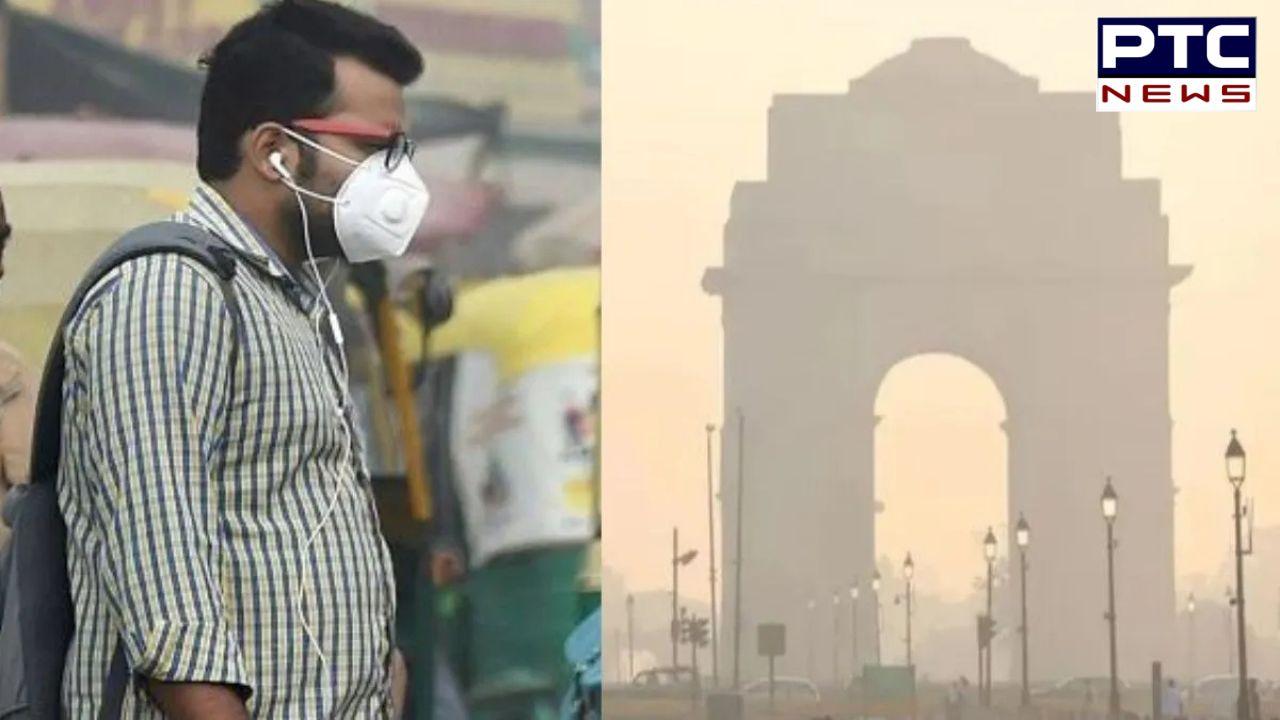
PTC News Desk: Delhi's air quality dropped sharply on Monday morning, just hours after Diwali celebrations and firecracker bursting continued until midnight. According to official data, the city's Air Quality Index (AQI) reached 483 at 8:10 am, placing it in the 'severe' category. However, private monitoring agencies, including Swiss-based IQAir, reported AQI levels above 1,000 in areas such as Shahdara and Defence Colony in south Delhi.
The pollution levels increased despite Stage III restrictions under the Graded Response Action Plan (GRAP) already being in force across Delhi-NCR. According to the Central Pollution Control Board (CPCB), the city's AQI stood at 483. At least 15 monitoring stations recorded AQI levels above 400 as thick smoke and smog covered residential areas and major roads.
Why are AQI readings different across platforms
The CPCB measures AQI on a scale of 0 to 500. Any pollution level beyond the limit for an AQI of 500 is generally displayed as '500' or '500+'. This means that even if PM2.5 pollution rises much further, the official AQI may continue to show the same maximum reading.
This is because the AQI is designed to inform people about health risks rather than show exactly how much pollution has increased beyond the 'severe' category.
AQI and particulate matter (PM) levels are not the same. While the AQI may stop at 500, the actual concentration of harmful PM2.5 particles can continue to rise.
Private air-quality platforms may use different methods to calculate AQI. Some follow systems based on the US Environmental Protection Agency's guidelines, while others use their own health-risk measurements. As a result, the same pollution levels can produce different AQI readings on different platforms.
Several areas record 'severe' pollution
RK Puram and Nehru Nagar, near Lajpat Nagar in south Delhi, were among the worst-affected areas until 9 pm. Pollution levels had started rising sharply, but the Delhi Pollution Control Committee's (DPCC) website reportedly stopped showing live readings from several monitoring stations for a few hours, according to news agency IANS. This affected the availability of data during the period when pollution was at its peak.
At the busy ITO intersection, where the CPCB recorded an AQI of 407, commuters and pedestrians struggled to breathe in the thick smog. Many complained of headaches and burning eyes.
A few kilometres away, heavy smog completely covered the view of Akshardham temple from a nearby flyover. On the Delhi-Noida border and in north Delhi's Inderlok area, drivers had to switch on their headlights in the morning to see through the dense fog-like pollution.
Data from the CPCB's Sameer mobile app and local monitoring stations showed that several parts of Delhi were facing extremely high pollution levels.
Some of the areas with severe AQI readings included:
Vivek Vihar: 445 (another CPCB hourly reading showed 437)
Burari Crossing: 441
Jahangirpuri: 433–442
Rohini: 430–438
Delhi Technological University (DTU): 430–434
North Campus: 433
Bawana: 427
Ghazipur: 418
Mundka: 417
Punjabi Bagh: 408–409
National Institute of Health, Narela: 407
Private monitoring agency IQAir reported an AQI above 1,000 in Shahdara.
Some other areas recorded slightly lower pollution levels and remained in the 'very poor' category. The Central Road Research Institute (CRRI) on Mathura Road recorded an AQI of 396, while Dr Karni Singh Shooting Range recorded 361 and Najafgarh 340.
GRAP III restrictions in place
The sharp rise in pollution after Diwali came despite authorities imposing Stage III restrictions under GRAP on Friday, three days before the festival. The decision was based on pollution and weather forecasts from the India Meteorological Department (IMD) and the Indian Institute of Tropical Meteorology (IITM).
The Commission for Air Quality Management (CAQM) manages the four-stage GRAP system in coordination with the CPCB and state governments in Delhi and nearby districts of Haryana, Uttar Pradesh and Rajasthan. Each stage brings stricter measures to control pollution.
According to CPCB guidelines, AQI levels are classified as follows:
0–50: Good
51–100: Satisfactory
101–200: Moderate
201–300: Poor
301–400: Very Poor
401–500: Severe
Stage III is generally imposed when AQI reaches the severe range of 401–450. Under this stage, non-essential construction work is stopped, restrictions on vehicles are tightened and primary school students may attend classes in a hybrid mode.
Pollution rise in other cities also
Poor air quality was also reported in other parts of the country on Monday morning.
In Uttar Pradesh, thick smog covered several areas of Lucknow. In Mumbai, haze was seen over Kalanagar and Bandra.
Mumbai's monitoring stations recorded an AQI of 264 in Kherwadi-Bandra East, 226 in Sewri and 221 in Ghatkopar, among other areas.
- PTC NEWS