World watches closely as Trump, Putin all set to hold high-security Alaska summit today in bid to break Russia-Ukraine deadlock





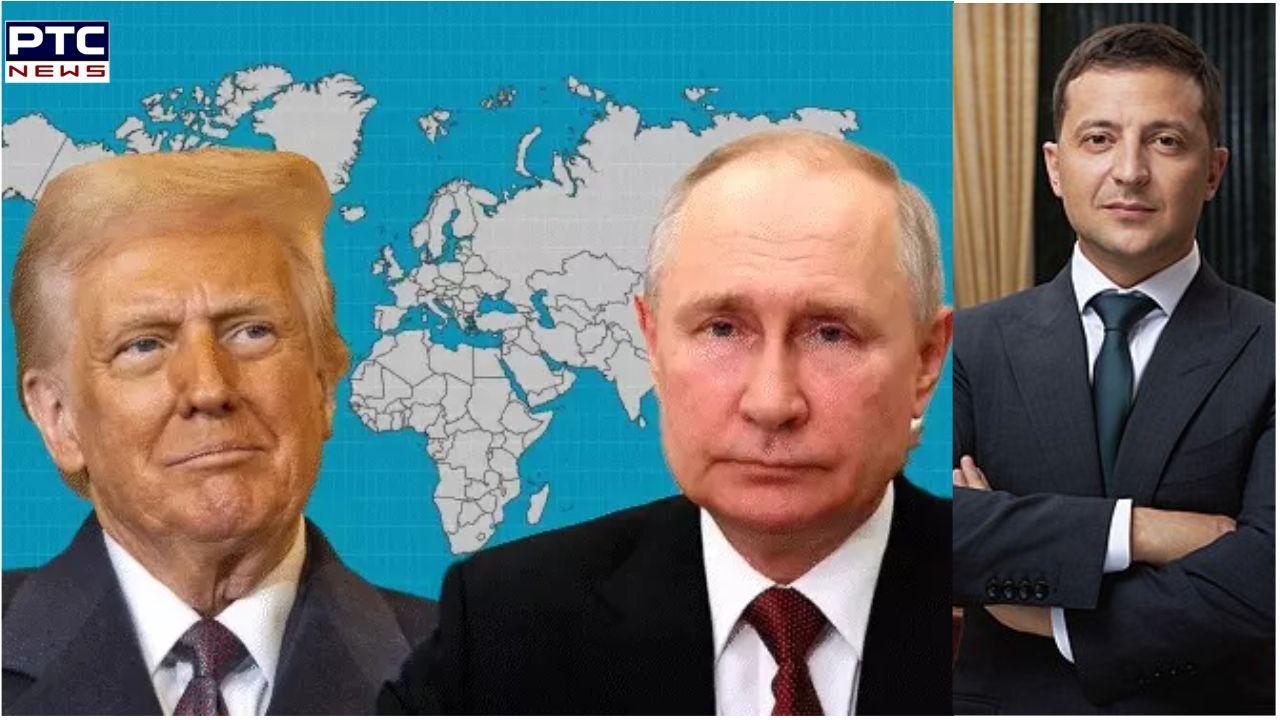
PTC Web Desk: US President Donald Trump and Russian President Vladimir Putin are set to meet on August 15 in Anchorage, Alaska, marking their first face-to-face meeting in seven years. The high-stakes agenda: finding a way to end the ongoing Russia-Ukraine war.
The one-on-one talks will be held at the Elmendorf-Richardson Military Base, the largest military facility in Alaska, with only one translator present. While the exact details of their discussion will not be disclosed, both leaders are scheduled to hold a joint press conference afterward. This military base has historical significance — 54 years ago, in 1971, it hosted the landmark meeting between US President Richard Nixon and Japanese Emperor Hirohito.
Ahead of Putin’s arrival, his armoured Aurus Senat limousine has already been flown in by a Russian cargo aircraft. Even the water bottles and cups to be used during the meeting will be sealed by Putin’s team. Russian fighter jets have been stationed in Anadyr, about 88 km from Alaska.
Putin will be accompanied by his Federal Protective Service (FSO) unit, tasked with ensuring his safety during foreign visits. The US has deployed 32,000 troops already stationed at the base, and Trump’s security protocol will include KH-11 reconnaissance satellites and a fully air-gapped (offline) cyber network for the facility. A no-fly zone covering a 300 km radius will be enforced, with double-layered security—military police and National Guard forming the first ring, and Special Forces with Secret Service counter-assault teams forming the second. Trump’s Air Force One will remain under constant military guard.
Trump and Putin’s meeting follows years of escalating conflict since the war began in 2022. During his 2023–24 presidential campaign, Trump pledged to end the war within 24 hours of taking office. Over six months into his presidency, that promise remains unfulfilled.
Instead, Russia has intensified its airstrikes on Ukraine. In response, Trump gave Moscow a 50-day deadline to enter peace talks or face tougher US sanctions. That deadline expired on August 8. Two days before it ended, US Special Envoy Steve Witkoff met Putin in Moscow, paving the way for the Alaska meeting.
Despite the talks, the White House has dismissed expectations of an immediate ceasefire, stating that the objective is to explore possible pathways to end the war.
Why Alaska?
According to the BBC, the choice of Alaska is primarily for security reasons. The state’s mainland is just 90 km from Russia’s Chukotka region, allowing Putin to fly in without crossing “enemy” airspace. The region also houses Russian air force bases and military monitoring stations, possibly with nuclear weapons.
The second reason is distance — Alaska is far from Ukraine and Europe, aligning with Putin’s preference to negotiate directly with the US without the involvement of Kyiv or EU leaders.
The sticking points
Russia currently controls about 20% of Ukrainian territory (approximately 114,500 sq km), including Crimea, Donetsk, Luhansk, Kherson, and Zaporizhzhia. Putin has made it clear that peace talks can only proceed if Ukraine relinquishes claims to these territories and accepts them as part of Russia, while also abandoning its bid to join NATO.
The Ukrainian President, Volodymyr Zelenskyy, has rejected these demands outright, insisting that Ukraine will not cede “even an inch” of its land. He argues that any retreat would weaken Ukraine’s sovereignty and embolden Russia to attack again.
On August 13, Trump held a virtual meeting with Ukrainian President and European leaders, suggesting land swaps as part of a peace deal. Zelensky, however, called for an unconditional ceasefire and demanded security guarantees, ruling out any territorial concessions.
Europe’s stance
European powers, particularly Germany, Britain, and France, oppose Ukraine’s surrender and reject Russia’s terms. German Chancellor Friedrich Merz urged Trump to prioritise Ukrainian security during talks with Putin. French President Emmanuel Macron stated that any discussion of territorial exchange must involve Ukraine directly.
British Prime Minister Keir Starmer’s spokesperson emphasised that Ukraine should receive credible security guarantees under any peace agreement.
As Trump and Putin prepare to meet in Alaska, the world watches closely, though a breakthrough on a ceasefire appears unlikely in the immediate aftermath.
- With inputs from agencies