Election for Vice President to be held on September 9, result same day | How India elects its Vice President





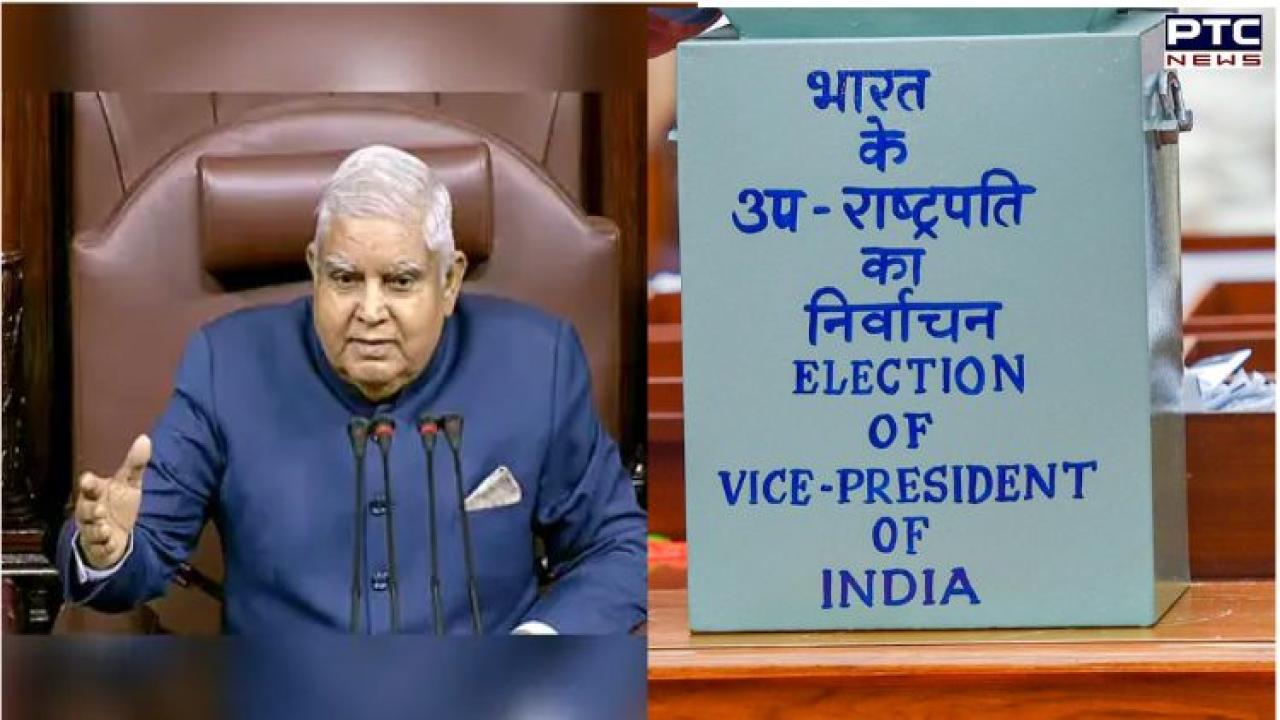
PTC Web Desk: The Election Commission of India has officially announced that the Vice President election 2025 will be held on September 9. This announcement comes after the sudden resignation of Vice President Jagdeep Dhankhar last month, prompting the need for a fresh poll.
As per the election schedule, the notification for the Vice President election will be issued on August 7, and the last date to file nomination papers is August 21. The counting of votes and result declaration will be conducted on the same day as polling, September 9.
The Election Commission has assured that the entire process will be conducted in a free and fair manner, following all constitutional guidelines.
How India elects its Vice President
Unlike the post of the President, where the Vice President takes over in an acting capacity, the Indian Constitution does not permit the appointment of an acting Vice President in the event of a mid-term vacancy.
As per constitutional provisions, the only option is to conduct a fresh election without delay.
Temporary arrangement in Rajya Sabha
The Vice President also holds the position of ex-officio Chairman of the Rajya Sabha. Until a new Vice President is elected, this role is being carried out by Deputy Chairman Harivansh Narayan Singh, who is overseeing the parliamentary responsibilities in a temporary capacity. However, this arrangement is limited to parliamentary proceedings only, and does not confer upon him the powers or designation of Vice President.
Dhankhar’s tenure and successor’s term
Jagdeep Dhankhar assumed office on August 11, 2022, replacing M Venkaiah Naidu, and had over two years remaining in his five-year term. However, his successor will not serve the remaining period — instead, the new Vice President will be elected for a full five-year term starting from the date of assuming office.
How the Vice President is elected
The Vice Presidential election is an indirect election conducted through an electoral college made up exclusively of Members of Parliament (MPs) from both Lok Sabha and Rajya Sabha, including nominated members. State Assemblies (MLAs) have no role in this election, unlike in the Presidential polls.
Voting is conducted via secret ballot using the single transferable vote system based on proportional representation. Importantly, party whips do not apply, meaning MPs can vote according to their individual choice.
The key distinction between the Presidential and Vice Presidential elections lies in the composition of the electoral college — in Presidential polls, nominated members and MLAs of the state legislatures also vote, whereas for the Vice President, only MPs — both elected and nominated — are eligible to participate.
Eligibility criteria for candidates
To be eligible to contest the Vice Presidential election, a candidate must: Be a citizen of India, be at least 35 years old, be qualified for election as a member of the Rajya Sabha and not hold any office of profit under the government.
A candidate’s nomination paper must be signed by at least 20 proposers and 20 seconders, all of whom must be eligible electors.
The Constitution allows for multiple terms in office, and a former Vice President is eligible to contest again, whether immediately after completing a term or at a later stage. Notably, Dr. S Radhakrishnan (1952–1962) and Mohammad Hamid Ansari (2007–2017) served two consecutive terms as Vice President.
Role in Presidential succession
The Vice President holds the second-highest constitutional position in India, ranking directly after the President and is first in the line of succession. If the President is unable to perform duties due to absence, illness, or other reasons, the Vice President steps in as acting President for up to six months. During such a period, the Vice President does not perform Rajya Sabha duties.
Election timeline and constitutional mandate
According to the Presidential and Vice-Presidential Elections Act, 1952, the entire election process — from notification, nomination, scrutiny, withdrawal, polling, to counting — must be concluded within 32 days of issuing the notification. Although Article 68(2) of the Constitution does not prescribe an exact timeline for mid-term elections, it mandates that the process be completed “as soon as possible.” A new Vice President is likely to take office by the last week of August 2025.
Who has the numbers?
With the Vice President elected solely by Parliament members, the ruling NDA (National Democratic Alliance) holds a clear numerical advantage. Currently, the total strength of Parliament stands at 786 members, factoring in six vacancies. Assuming full attendance, a candidate needs 394 votes to win.
The NDA enjoys robust support, with 293 MPs in the Lok Sabha and 129 MPs in the Rajya Sabha, giving it a total of 422 votes — comfortably above the required threshold.
- With inputs from agencies