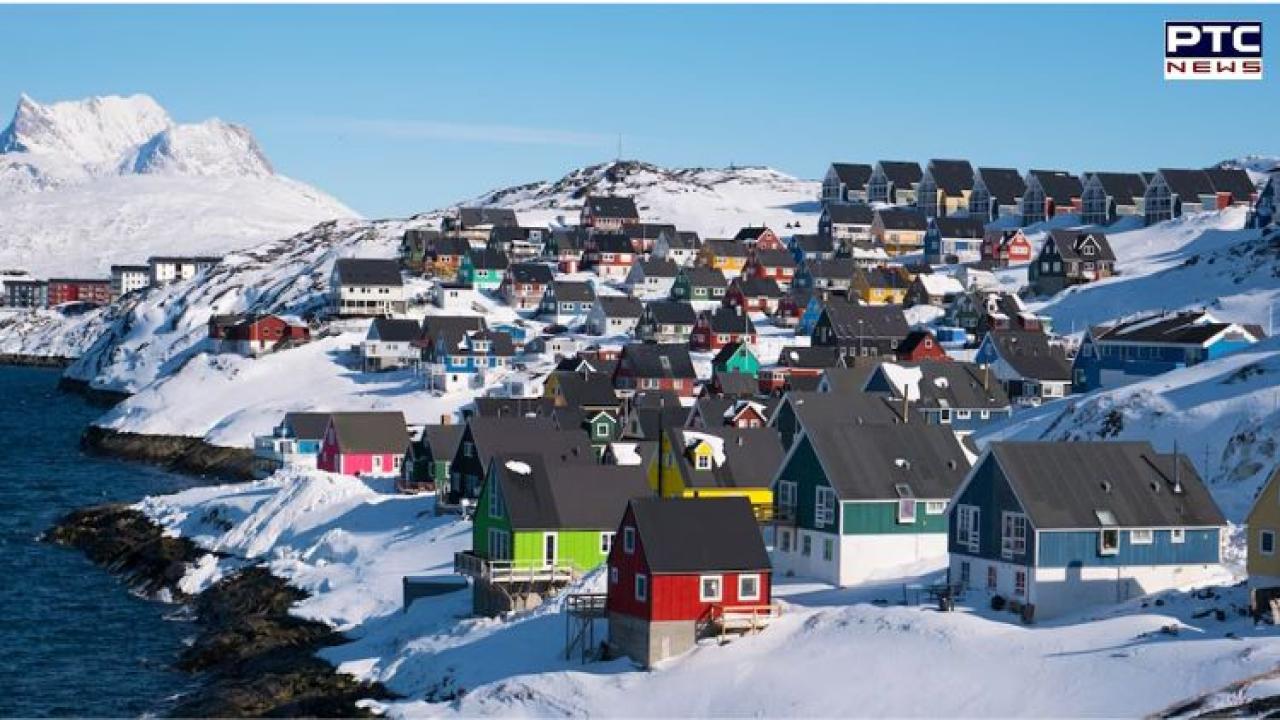
Explained: Why Greenland is emerging as the centre of global power politics





PTC Web Desk: Once regarded as a remote, ice-covered landmass far from the centres of global decision-making, Greenland is rapidly gaining prominence in international geopolitics. Accelerating climate change, shrinking Arctic ice and intensifying rivalry among major world powers are transforming the world’s largest island into a zone of growing strategic, economic and military interest.
What was long dismissed as an uninhabitable frozen territory is now being viewed as a critical gateway to future trade corridors, mineral resources and security dominance in the Arctic.
Climate change is rewriting the Arctic reality
The Arctic region is warming at a pace far exceeding the global average, and Greenland is among the most visible examples of this transformation. Over the past few decades, Arctic sea ice has receded dramatically, exposing ocean routes and land areas that were previously locked beneath ice for most of the year.
As a result, the Arctic is no longer seen solely as a frozen obstacle. Instead, it is gradually turning into a navigable maritime space, with seasonal shipping routes becoming more reliable. This shift has the potential to alter how goods move between Asia, Europe and North America, reducing travel time and transportation costs.
Climate change, once treated primarily as an environmental issue, has now become a powerful driver of geopolitical change.
Strategic location amplifies Greenland’s importance
Greenland’s geographical position gives it strategic weight far beyond its population size. Located between North America and Europe, the island sits near critical Arctic maritime routes and close to areas where the interests of the United States, Russia and Europe converge.
Although Greenland enjoys self-rule, it remains part of the Kingdom of Denmark, a NATO member. This makes the island an integral element of NATO’s northern defence architecture. The United States already operates a military base in Greenland, which plays a key role in missile detection, space surveillance and early-warning systems.
Its vast size further enhances its strategic value. Greenland covers more area than several major European nations combined, making long-term influence over the island a significant geopolitical advantage.
Vast mineral reserves attract global interest
In addition to its location, Greenland’s resource potential has drawn growing attention. Geological studies indicate that the island holds substantial reserves of rare earth elements and other critical minerals essential for modern industries.
These materials are crucial for electric vehicles, renewable energy infrastructure, advanced electronics and defence technologies. As countries race to secure supply chains for clean energy and high-tech manufacturing, access to such minerals has become a strategic priority.
Harsh weather, thick ice and environmental constraints have so far limited large-scale mining. However, as ice cover continues to decline, exploration and extraction are becoming more feasible, drawing interest from global investors and governments alike.
Arctic shipping routes could transform global trade
One of the most significant developments in the region is the gradual opening of Arctic sea routes. The Northern Sea Route, which runs along Russia’s Arctic coastline, offers a much shorter link between Europe and Asia compared to traditional routes through the Suez Canal.
Recent commercial voyages have highlighted the route’s potential, cutting shipping times by several weeks. Vessel traffic through key passages such as the Bering Strait has increased steadily, signalling growing confidence among shipping operators.
Despite lingering risks from unpredictable ice conditions and limited infrastructure, these routes are increasingly seen as viable alternatives in a warming Arctic.
Russia deepens its Arctic strategy
Russia has emerged as the most active power in the Arctic. For Moscow, the region represents both economic opportunity and strategic necessity. The Kremlin has invested heavily in Arctic infrastructure, including ports, icebreakers and military facilities, while reviving several bases from the Soviet era.
Control over the Northern Sea Route is central to Russia’s long-term economic and security planning. Even amid the ongoing conflict in Ukraine, Russia has maintained a strong Arctic posture, underscoring the region’s importance in its strategic calculations.
NATO expansion and China’s growing role
The Arctic security landscape has shifted further with Finland and Sweden joining NATO. Their inclusion has extended NATO’s reach closer to Russia’s northern borders, intensifying strategic competition in the region.
NATO countries have responded by expanding joint military exercises, enhancing surveillance and investing in ice-capable naval assets. Denmark has also stepped up coordination with Nordic allies to strengthen Arctic monitoring and defence.
China, meanwhile, has increased its engagement by describing itself as a “near-Arctic state” and expanding scientific, commercial and logistical activities, including the deployment of icebreakers for research missions.
Why Greenland matters for India
Greenland’s changing role also holds implications for India. Arctic warming directly influences global climate systems, including the Indian monsoon. The melting of Greenland’s ice sheet contributes to rising sea levels, posing long-term risks to India’s coastal regions.
India has been engaged in Arctic research since 2007 and operates the ‘Himadri’ research station in Norway’s Svalbard region. Data from Greenland and surrounding Arctic areas helps Indian scientists study the link between Arctic warming, Himalayan glaciers and river systems that support millions of people.
India is also exploring cooperation in Arctic shipping and critical minerals under its Arctic policy, with an emphasis on sustainability and international norms.
A new centre of global competition
Greenland is no longer just a distant, frozen frontier. It is quickly becoming a strategic crossroads where climate change, resource competition, global trade and military power intersect.
As Arctic ice continues to retreat and geopolitical rivalry intensifies, Greenland and the broader Arctic region are poised to play a decisive role in shaping the future balance of global power.
- With inputs from agencies