Heatwave 2026: Why humidity could make this summer more dangerous; why India is at high risk





Heatwave 2026: As summer begins across India, the India Meteorological Department has already warned that many parts of the country could see more heatwave days than usual between April and June. Temperatures in several regions are already touching 42–45°C and experts say this season could break previous records.
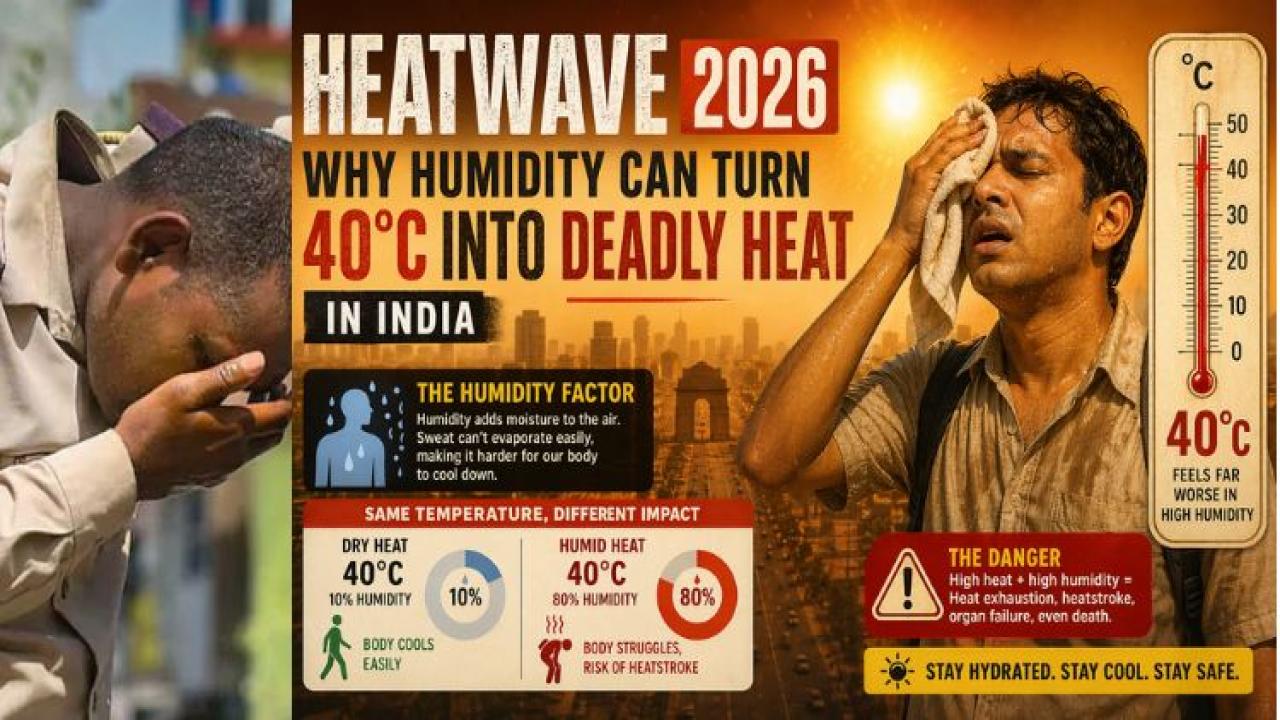
But temperature alone does not tell the full story. As per a report in India Today, scientists are now warning that humidity could make the heat far more dangerous.
The human body cools itself mainly by sweating. When sweat dries or evaporates from the skin, it removes heat and helps the body stay cool.
In dry regions like Delhi or Rajasthan, this process works relatively well, even when temperatures are high.
However, in humid weather, the air already contains a lot of moisture. This makes it difficult for sweat to evaporate. As a result, the body cannot cool down properly.
This can lead to serious health problems such as increased heart rate, high blood pressure and in extreme cases, organ failure.
To understand this combined effect of heat and humidity, scientists use something called wet-bulb temperature (WBT). Unlike normal temperature readings, WBT shows how heat and moisture together affect the human body.
For a long time, experts believed that humans could survive up to a WBT of 35°C. Beyond this point, sweating stops being effective. But recent research has challenged this belief.
A major study by the Penn State HEAT Project, led by W Larry Kenney, found that even healthy young adults start struggling much earlier. The study showed that the body begins to lose its ability to control internal temperature at a WBT of around 31°C, which is lower than earlier estimates.
In simple terms, even a temperature of 38°C with 60% humidity can push the body beyond safe limits.
The risk becomes even higher for elderly people, those on medication or people with existing health conditions.
Another study by Akshay Deoras from the University of Reading highlights that moist heatwaves in India are often ignored. People are more familiar with dry heat, but humid heat can be more dangerous because it is less noticeable.
India is particularly vulnerable due to its climate and geography. An IMD study found that wet-bulb temperatures have been rising along coastal areas over the past few decades.
Even the monsoon, which usually brings relief, can increase the risk. During active monsoon phases, moisture levels rise sharply, increasing heat stress. When the monsoon weakens, the risk shifts to southern regions like Kerala.
Studies suggest that by the end of this century, nearly 70% of India’s population could face wet-bulb temperatures of 32°C or more. Around 2% of people could experience levels above 35°C, which is considered extremely dangerous and potentially fatal.
The IMD has already predicted more heatwave days across many parts of India this year. Experts believe 2026 could be even hotter than the extreme summer of 2024.
Anjal Prakash, an author with the Intergovernmental Panel on Climate Change, warned that rising humidity will make heat feel much worse.
He explained that 40°C can feel like 50°C in humid conditions, and survival without cooling systems like air conditioners may become difficult in the future.
Experts say people should not rely only on temperature readings anymore. Humidity plays an equally important role in how heat affects the body.
- With inputs from agencies