Operation Sindoor explained: Timeline of the 4-day India-Pakistan conflict in May 2025





Operation Sindoor: A brief but intense four-day conflict between India and Pakistan began on May 7, 2025, after India launched Operation Sindoor, targeting terror infrastructure linked to Jaish-e-Mohammed and Lashkar-e-Taiba in Pakistan and Pakistan-administered Kashmir in response to the Pahalgam attack that killed 26 civilians. Pakistan denied involvement and claimed civilian areas were hit.
The escalation saw cross-border shelling, drone strikes and missile exchanges, marking the first drone conflict between the two nuclear powers. Both sides accused each other of targeting air bases on May 10, with Pakistan launching Operation Bunyan-un-Marsoos in retaliation. The hostilities ended the same day after a ceasefire agreement following DGMO-level talks, with international mediation playing a role.
AI GENERATED IMAGE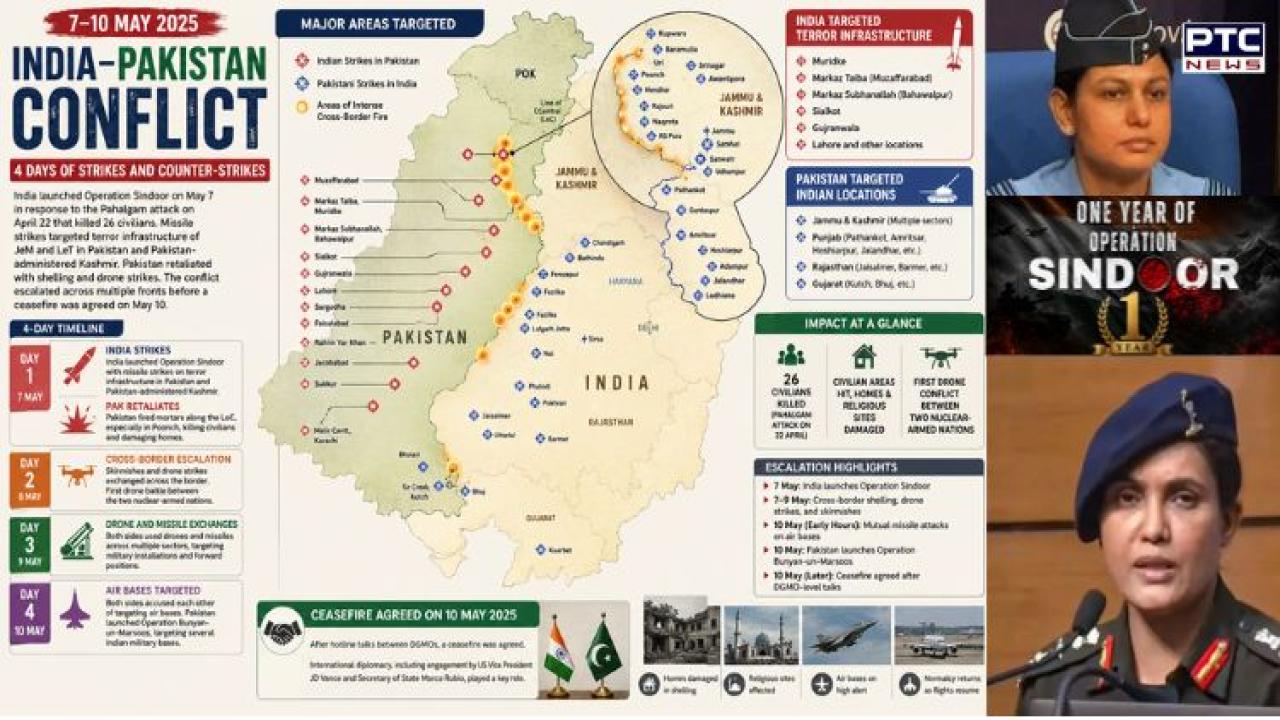
India launched Operation Sindoor in the early hours of May 7, 2025, around 1.05 am, targeting what it described as terrorist infrastructure across Pakistan and Pakistan-occupied Kashmir (PoK). The operation was carried out in retaliation for the April 22 Pahalgam attack.
Indian forces conducted precision strikes on nine sites, including key terror hubs such as Muridke, Bahawalpur and areas near Muzaffarabad. These locations are believed to host training camps and logistical bases of militant groups.
Within hours, Pakistan responded with retaliatory strikes, primarily focusing on Indian positions along the border.
India’s opening strikes targeted terror infrastructure across PoK and Pakistan’s Punjab province. In response, Pakistan initiated heavy shelling along the Line of Control (LoC), leading to casualties on the Indian side, with at least 13 persons reported killed.
The conflict widened significantly on the second day. India reported repelling multiple Pakistani strikes across Jammu & Kashmir, Punjab, Rajasthan and Gujarat.
In retaliation, India struck Pakistani air defence systems in major cities, including Lahore, Rawalpindi and Karachi, as well as military-linked facilities in Gujranwala. The targeting of air defence infrastructure indicated a shift towards degrading Pakistan’s military capabilities rather than just counter-terror operations.
Pakistan escalated the situation further by deploying drones to strike multiple regions across northern and western India. Most of these drone incursions were intercepted or neutralised, according to Indian claims.
However, a drone strike in Ferozepur, Punjab, left three civilians injured, highlighting the growing risk to non-combatants. India responded with what it termed “appropriate countermeasures,” though specific details were not disclosed.
On the fourth day, India launched airstrikes on military targets inside Pakistan, including sites in Sialkot, Chaklala, and Murid. These strikes marked a significant escalation, as they directly targeted Pakistan’s military installations rather than non-state actors.
Later in the day, a ceasefire was announced, coming into effect at 5 pm. However, reports of violations soon emerged, with continued shelling along border areas raising concerns about the durability of the truce.
Indian strikes in Pakistan focused on terror bases and strategic locations in Punjab and PoK.
Pakistani strikes in India were concentrated along border districts such as Kupwara, Baramulla, Uri, Poonch, Rajouri, Jammu, and extending into Punjab cities like Amritsar, Pathankot, and Jalandhar.
Western sectors, including Rajasthan’s Jaisalmer and Gujarat’s Kutch region, also witnessed activity, indicating a multi-front engagement.
Rising Civilian Impact
The escalation saw increasing civilian exposure to conflict zones. Shelling, drone strikes and cross-border fire affected populated areas, damaging homes and infrastructure.
- With inputs from agencies