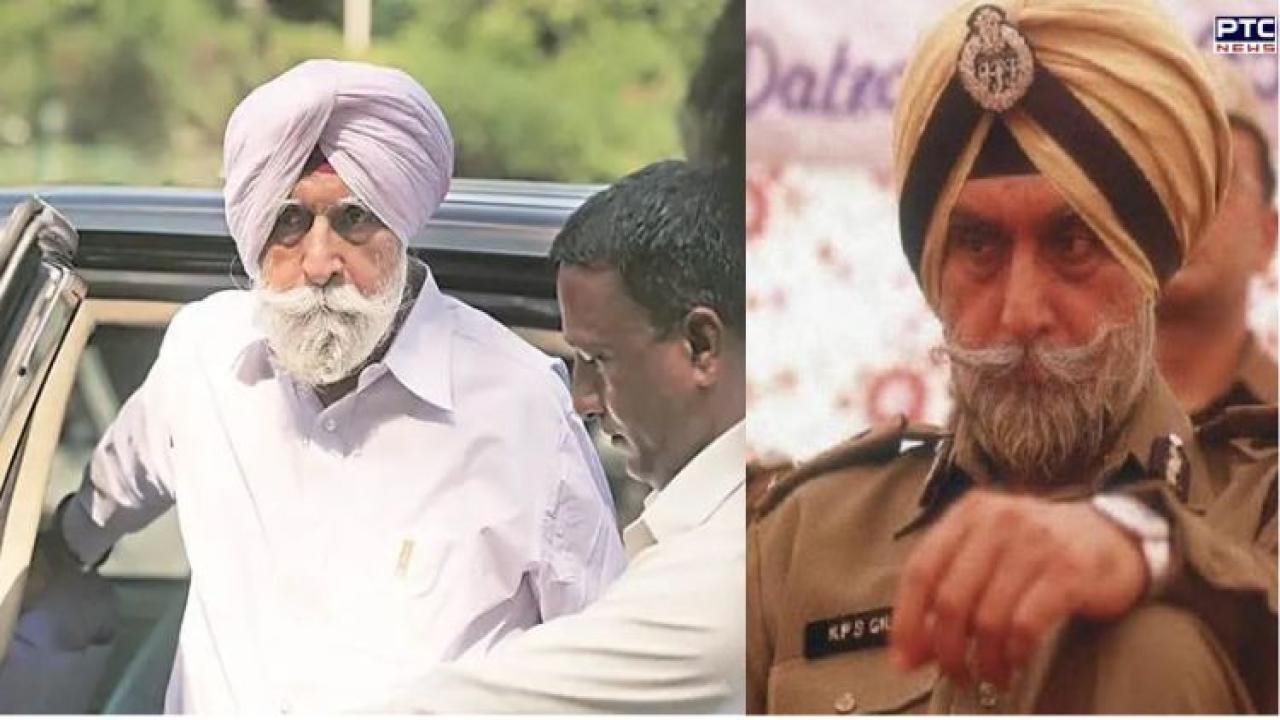
Who was KPS Gill? The 'supercop' who crushed Punjab militancy but left behind a deeply divided legacy





PTC Web Desk: Former Punjab Director General of Police (DGP) Kanwar Pal Singh (KPS) Gill continues to be one of the most debated figures in India's policing history. For many, he was the officer who led Punjab out of one of its darkest phases by breaking the back of the Khalistani insurgency. For others, his tenure remains linked to allegations of human rights violations and controversial policing methods.
Gill's name has once again entered public discussion following the release of Satluj, the Diljit Dosanjh-starrer based on the life of human rights activist Jaswant Singh Khalra. The film has revived conversations about Punjab's militancy years, the disappearance of Khalra and the role of the police during the state's counter-insurgency operations.
Although Gill consistently denied any involvement in Khalra's murder and was never convicted in the case, allegations surrounding the incident continued to follow him throughout his life.
In a 1993 interview with India Today Magazine, Gill dismissed the idea that there had ever been a clearly defined movement for Khalistan.
He argued that Jarnail Singh Bhindranwale often gave contradictory statements on the issue, at times appearing to support Khalistan and at other times distancing himself from such remarks. Gill also claimed that Bhindranwale and those around him frequently relied on the language of the Two-Nation Theory while addressing the issue.
The comments reflected Gill's confidence at a time when militancy in Punjab had significantly weakened after years of police action.
KPS Gill's legacy has resurfaced because of Satluj, earlier titled Panjab '95. The film is inspired by the life of Jaswant Singh Khalra, who documented alleged illegal cremations carried out during Punjab's anti-militancy campaign.
Khalra was abducted from outside his home in Amritsar on September 6, 1995, and was never seen again. A Central Bureau of Investigation (CBI) probe later concluded that he had been murdered, although his body was never recovered.
The film has itself been surrounded by controversy over censorship issues, delays in release and its removal from an OTT platform, bringing renewed attention to Gill's role during Punjab's turbulent years. Veteran actor Kanwaljit Singh portrays KPS Gill in the film.
Gill was born on December 29, 1934, in Ludhiana, Punjab. After Independence, his family shifted to Simla (now Shimla), where he spent much of his childhood.
His father, Rachpal Singh Gill, worked as a senior government engineer. Gill lost his mother, Amrit Kaur, at a young age, an event that friends later said deeply affected him. He completed his graduation in English from Panjab University before joining the Indian Police Service (IPS) in 1958. He was allotted the Assam-Meghalaya cadre, where he began his policing career.
Before becoming synonymous with Punjab, Gill's career was marked by controversy in Assam.
As DIG, he served during the Assam Agitation between 1979 and 1985, a mass movement led by the All Assam Students' Union (AASU) against illegal immigration. One of the defining moments came on December 10, 1979, when Khargeshwar Talukdar, a 22-year-old student leader, died after police cracked down on protesters attempting to stop Begum Abida Ahmed, wife of former President Fakhruddin Ali Ahmed, from filing her nomination papers in Barpeta.
Protesters accused Gill of ordering the lathi-charge that led to Talukdar's fatal injuries. The incident remains one of the most controversial episodes of his career.
The Assam agitation also witnessed widespread violence against Bengali-speaking residents, many of whom were viewed by sections of the movement as illegal immigrants.
Gill later returned to Assam as Security Adviser to the Asom Gana Parishad (AGP) government and continued to speak on issues such as the 1983 Nellie massacre and implementation of the Assam Accord.
Gill's biggest challenge came when he was appointed Punjab DGP during the peak of the Khalistani insurgency. The state had witnessed escalating violence following Operation Blue Star in 1984 and the assassination of former Prime Minister Indira Gandhi later that year. He first became Punjab DGP in 1988.
One of the most significant operations during his tenure was Operation Black Thunder II in May 1988. Unlike Operation Blue Star, security forces surrounded the Golden Temple complex, negotiated with militants and carried out a carefully planned operation that resulted in far less damage to the shrine.
Gill completed his first term as Punjab DGP in December 1990 before briefly heading the Central Reserve Police Force (CRPF). He returned as Punjab DGP in late 1991 with the backing of then Chief Minister Beant Singh.
During his second tenure, Gill adopted an aggressive strategy against militant groups. His approach relied on better intelligence gathering, strengthening local policing, rewarding officers involved in anti-militancy operations and maintaining constant pressure on insurgent organisations. Supporters argue these measures played a crucial role in restoring law and order.
By the mid-1990s, violence in Punjab had sharply declined and the Khalistani insurgency had largely been defeated, earning Gill the reputation of a "Supercop".
Despite being credited with restoring peace, Gill's tenure has remained controversial. Human rights organisations accused the Punjab Police of carrying out fake encounters, custodial killings and enforced disappearances during the anti-insurgency campaign.
Gill consistently defended the police, maintaining that extraordinary circumstances required extraordinary action to defeat terrorism.
Among the most debated chapters of Gill's career is the disappearance and murder of human rights activist Jaswant Singh Khalra.
Khalra had documented alleged secret cremations of thousands of unidentified people, claiming they had been carried out by the Punjab Police during the militancy years.
He was abducted from outside his residence in Amritsar on September 6, 1995.
A CBI investigation later concluded that Khalra had been illegally detained and murdered. His body, however, has never been recovered.
Six Punjab Police personnel were eventually convicted for kidnapping and murdering Khalra.
Gill was never chargesheeted or convicted in the case and repeatedly denied any role. However, eyewitness accounts and human rights activists continued to allege that he was part of the larger conspiracy, keeping the controversy alive for decades.
Gill retired as Punjab DGP on December 31, 1995, after receiving multiple service extensions due to the state's security situation.
His retirement came only months after Punjab Chief Minister Beant Singh was assassinated in a bomb blast carried out by Khalistani terrorist outfit Babbar Khalsa International in Chandigarh.
Following retirement, Gill established the Institute of Conflict Management in New Delhi and regularly wrote and spoke on terrorism, policing and national security.
In 1996, Gill's public image suffered another setback. He was convicted for sexually harassing senior IAS officer Rupan Deol Bajaj during an official gathering. The case drew national attention and became one of the most high-profile sexual harassment cases involving a senior police officer.
Gill later served as President of the Indian Hockey Federation and continued to comment on national security issues. In 2012, campaigners in the United Kingdom successfully opposed his visit to the London Olympics, accusing him of responsibility for widespread human rights violations during Punjab's anti-insurgency operations.
KPS Gill died in 2017.
Nearly three decades after his retirement, KPS Gill remains one of the most polarising figures in Indian policing. To his supporters, he was the officer who restored peace to Punjab by defeating one of the country's deadliest insurgencies. To his critics, the return of normalcy came at the cost of serious human rights concerns that have never been fully addressed.
- With inputs from agencies